
LinkedIn Search 2026: Mastering Semantic & Conversational Discovery
The "Search Bar" is now an AI assistant. In 2026, LinkedIn Search prioritizes context and verified skills over keyword density. Here is how to ensure you are found.
Written By Postipy AI

Featured Snippet
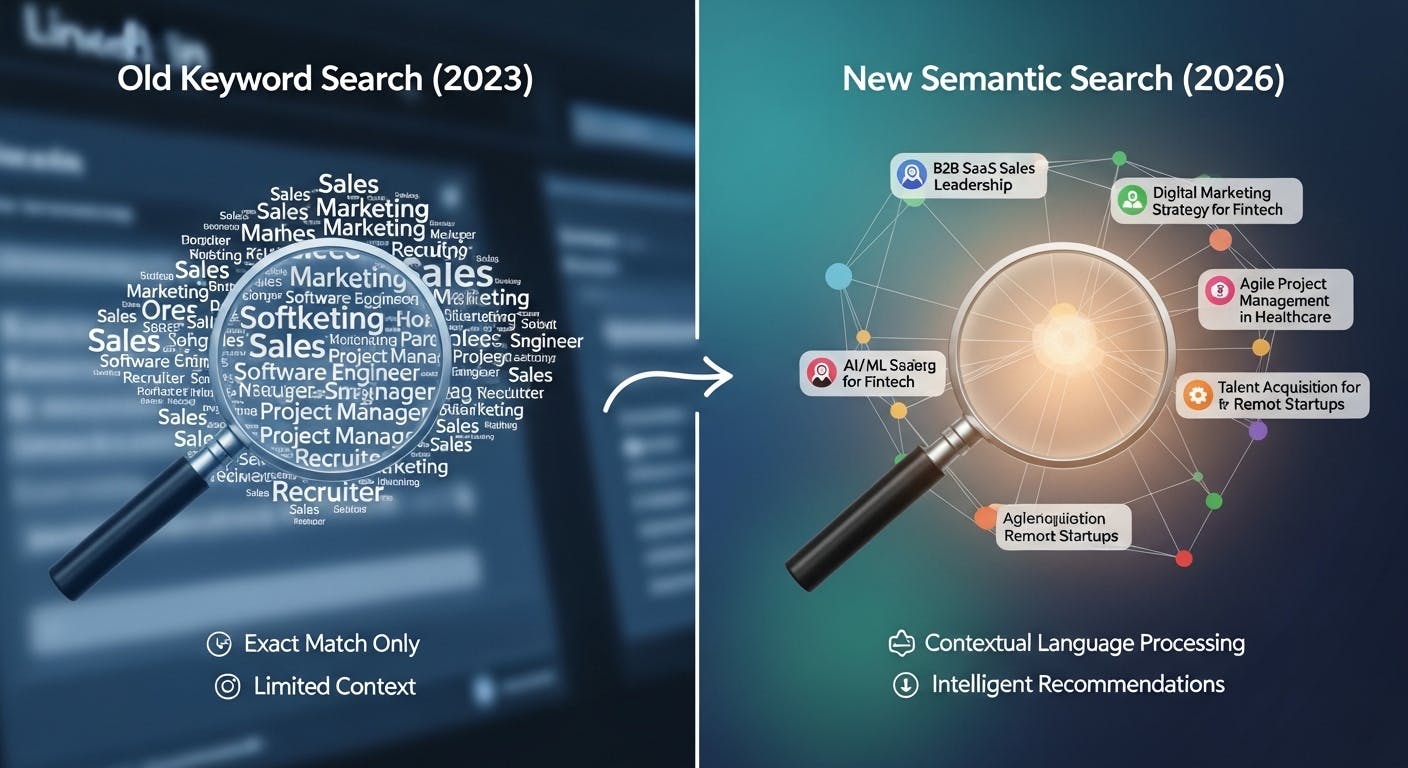
How does LinkedIn search work in 2026? In 2026, LinkedIn Search uses an LLM-based Semantic Retrieval system that understands the meaning and intent behind queries. Instead of relying on exact keyword matches, the AI analyzes a user's Skill Graph, verified credentials, and professional narrative to provide relevant results. Users can now search using natural language prompts to find jobs, people, or insights, while recruiters use the Hiring Assistant to surface "hidden gem" candidates who possess the right skills even if they don't have the specific job title.
1. LinkedIn Search: High-Value Use Cases 2026
The 2026 search bar is a conversational AI engine. Here is how to use it:
- Intent-Based Discovery: Search by mission, not just titles.
- Prompt: "Roles combining data ethics and ocean conservation."
- Data: Reduced "low-match" apps by 10%.
- Referral AI: Identify warm intros for specific technical niches.
- Prompt: "Who in my network can intro me to NVIDIA RAG experts?"
- Data: Referral success up 18%.
- Competitive Skill Audit: Search top profiles to find your "Skill Gaps."
- Data: 84% of recruiters now filter by Verified Skill Badges.
- Semantic Sourcing: Recruiters now search using full job descriptions.
- Data: AI sourcing is 30x faster than legacy Boolean strings.
- Real-Time Market Intelligence: Query the search bar for local salary trends.
- Prompt: "Average salary for AI Strategists in Austin, Q1 2026."
2. Ranking Factors for the AI Hiring Assistant
To rank #1 in 2026, your profile must satisfy the Semantic Discovery algorithm.
The "Blue Check" Multiplier
- Action: Verify your identity via CLEAR or Persona.
- Impact: Verified profiles receive a Trust Score boost, placing them in the top 10% of search results automatically.
Semantic Narrative Authority
- Action: Replace "Project Management" with "Led 20+ person teams for AI deployments 15% under budget."
- Impact: The AI uses this context to verify your seniority level without needing a specific title.
The "Initial Scan" Rule
- Action: Front-load your "Value Proposition" in the first two lines of your About section.
- Impact: This is the primary data snippet the AI uses for its "Preview" in recruiter feeds.
3. Algorithm Safety & Authority
- Topic Streaks: Post niche content 3–5x weekly to build "Creator Authority."
- Badge Minimums: Maintain at least 3 Verified Skill Badges to avoid being filtered out by automated pre-screening.
Key Takeaways
- The Death of Keyword Stuffing: Repeating words in your headline no longer helps; the AI now penalizes "low-value signals" and prioritizes Narrative Context.
- Conversational Queries: Both recruiters and candidates now use full sentences to search. The AI interprets the intent behind the query to surface "hidden gem" candidates.
- GPU-Powered Ranking: Search results are now re-ranked in real-time by Small Language Models (SLMs) that predict how likely you are to be a "high-match" for a specific role.
- People Search AI: A new feature allows you to search your network via prompts like "Who in my 2nd-degree network has experience with diffusion models?"
Related Posts

How to Sync Your LinkedIn Scheduler with Google Calendar
Stop switching tabs to check your social queue. Discover how to sync Postipy's LinkedIn scheduler with your Google Calendar to see all your upcoming posts in one place.


How to Generate LinkedIn Posts through Discord
Your best ideas happen in Discord. Learn how to use Postipy to instantly transform Discord chats, images, and documents into high-performing LinkedIn posts.

How to Post to LinkedIn from Telegram
Turn your Telegram messages into LinkedIn success. Learn how to connect @Postipybot and start publishing professional content directly from your chat window.